
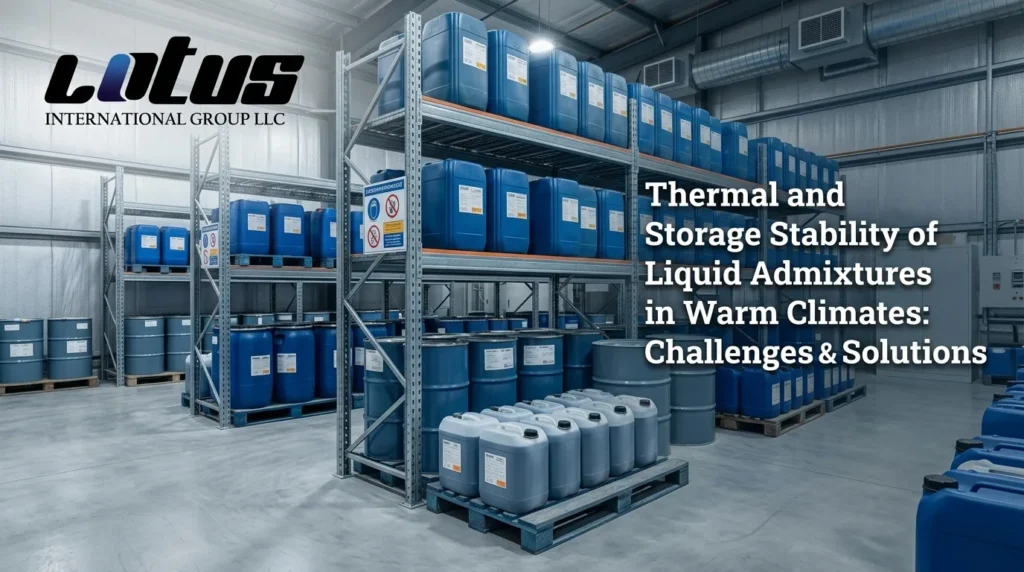
Introduction
In regions like North and Latin America, where temperatures often exceed 35°C (95°F), maintaining the thermal stability of liquid admixtures is a critical challenge for formulators and distributors. Liquid construction chemicals—such as PCE-based superplasticizers, retarders, and defoamers—are prone to degradation when exposed to heat during storage, transport, or even on-site conditions.
Failure to address these challenges can lead to:
- Phase separation (oiling out or layering)
- Viscosity loss or gelation
- Chemical degradation (hydrolysis, oxidation)
- Reduced performance in concrete applications
This article explores the science behind these issues and offers practical strategies to ensure liquid admixture stability under thermal stress.
Key Challenges of Thermal Instability
1. Phase Separation and Oiling Out
Many liquid admixtures are complex emulsions or dispersions. Heat can destabilize these systems, causing:
- Oil separation (especially in silicone-based defoamers or surfactant blends)
- Crystallization of PCEs or viscosity modifiers
- Precipitation of solid components due to solubility changes
This not only affects dosing accuracy but also leads to customer complaints and returns.
2. Viscosity Changes
High temperatures can either thin or thicken liquid admixtures, depending on the formulation:
- Thinning: Common in water-based systems where evaporation or polymer degradation occurs.
- Gelation: Some polymers cross-link under heat, leading to irreversible viscosity increases.
Both scenarios compromise pumpability and dosing precision.
3. Chemical Degradation
Thermal stress accelerates chemical reactions such as:
- Hydrolysis: Especially in ester-linked polymers (e.g., some PCEs).
- Oxidation: Common in unsaturated fatty acid derivatives or amines.
- Microbial Growth: In warm, humid environments, especially in glycol-based or natural surfactant systems.
Degradation reduces the active content and can generate byproducts that interfere with performance.
Solutions for Improving Thermal Stability
1. Formulation Strategies
a. Use of Stabilizers:
Additives like anti-settling agents (e.g., fumed silica), viscosity modifiers, or thermal stabilizers (e.g., antioxidants) can prevent phase separation and viscosity loss.
b. Encapsulation:
Encapsulating sensitive components (e.g., enzymes, certain defoamers) can protect them from heat and moisture until they are activated in the mix.
c. pH Control:
Maintaining the optimal pH range (typically 6–8 for PCEs) helps prevent hydrolysis and microbial growth.
2. Packaging and Storage
a. UV-Resistant Containers:
Use opaque or UV-stabilized plastic drums and totes to protect contents from light-induced degradation.
b. Temperature-Controlled Warehousing:
Store admixtures in cool, shaded areas with good ventilation. In tropical climates, air-conditioned storage may be necessary.
c. Shelf-Life Management:
Implement FIFO (First-In, First-Out) inventory systems to minimize long-term storage of temperature-sensitive products.
3. Supply Chain Best Practices
a. Insulated Transport:
Use insulated containers or refrigerated trucks during peak summer months.
b. Shorter Transit Times:
Work with regional distributors to reduce the time admixtures spend in transit.
c. Real-Time Monitoring:
Use temperature-sensitive labels or IoT sensors to track storage conditions during logistics.
Conclusion
The thermal stability of liquid admixtures is not just a technical issue—it’s a commercial imperative. In warm climates, even a slight degradation in product performance can lead to costly delays, customer dissatisfaction, and reputational damage.
At Lotus Chemical, we understand the unique challenges faced by manufacturers and distributors in North and Latin America. We offer:
- Thermally stable formulations of PCEs, defoamers, and retarders
- Technical support for optimizing storage and logistics
- Regional supply chain solutions to ensure product integrity from warehouse to site
Let us help you deliver high-performance admixtures that stand up to the heat.
Phase separation is often due to temperature fluctuations that destabilize emulsions or suspensions. This can be mitigated with stabilizers, proper packaging, and controlled storage conditions.
High temperatures can cause PCEs to degrade or crystallize, leading to either thinning or gelation. Using viscosity modifiers and UV-resistant packaging helps maintain consistency.
Store in cool, shaded areas with good airflow. Use UV-resistant containers and avoid exposing products to direct sunlight or extreme temperature variations.